 CREATION PLUS
Acer Aspire TC Review: A Dependable Budget Desktop with 14th Gen Power
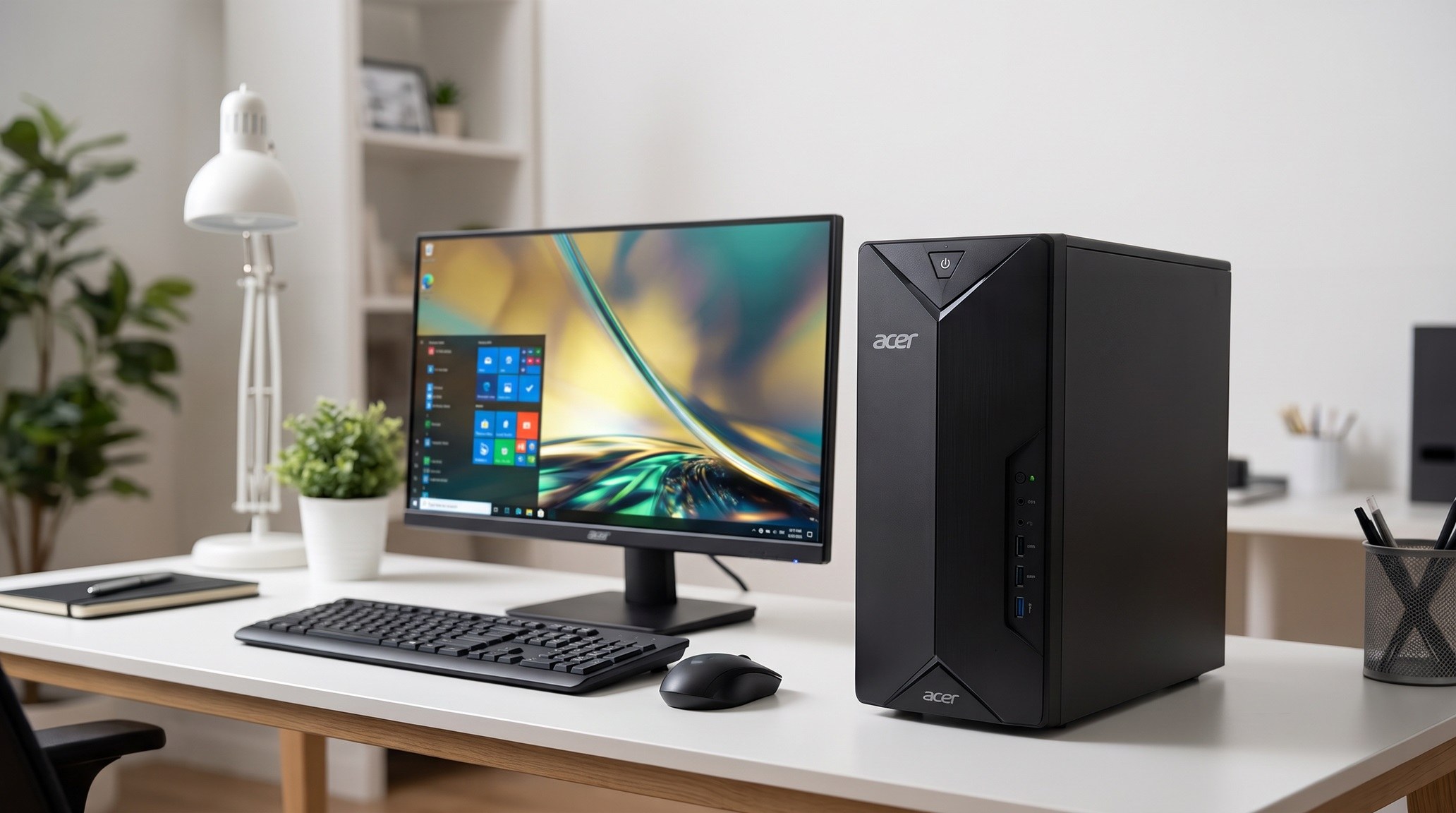
An exhaustive review of the Acer Aspire TC (TC-1775-UR11) desktop, analyzing its 14th Gen Intel Core performance, upgradability, value, and limitations.
About this analysis: we did not test this product ourselves. This article compiles the official specifications and benchmark results published by independent reviewers – every chart and table names its source.
Finding a reliable, capable desktop computer that balances modern processing power with an accessible price tag has become increasingly challenging in the current market. Acer addresses this mainstream segment with its enduring Aspire TC line, exemplified by the Acer Aspire TC-1775-UR11. As reviewed by PCMag, this desktop tower targets home offices, students, and family environments requiring dependable everyday computing power without crossing into premium pricing tiers. Launching with an official MSRP of $599.99 and frequently found on major retail platforms at street prices around $699.99, the Aspire TC sits firmly in the budget desktop tier. Much like budget-focused portables such as the Acer Aspire 3 A315 Review, this desktop prioritizes core productivity over extravagant extras, making it a compelling study in smart hardware compromises.
Over successive generations—including the earlier TC-1760-UA92, TC-390-UA92, and TC-895 iterations evaluated across mainstream channels—Acer has refined the Aspire TC formula. The updated 14th Generation Intel Core configuration brings notable processing uplifts, giving mainstream buyers a robust foundation for productivity suites, heavy web browsing, and multi-window multitasking. However, operating in the budget category inevitably involves compromises regarding graphical capabilities, power delivery, and thermal management. In this deep-dive analysis, we examine how the Acer Aspire TC stacks up against its competitors based on manufacturer specifications, professional benchmark testing from PCMag, and widespread owner feedback.
Specifications
The Acer Aspire TC-1775-UR11 packs a well-balanced array of mainstream components into its compact enclosure. Below is the complete technical specification sheet as provided by the manufacturer and verified by independent testing sources.
| Processor | |
|---|---|
| CPU | Intel Core i5-14400 (10 cores, up to 4.7 GHz boost) |
| Base Clock Speed | 1.8 GHz |
| Graphics | |
| GPU | Intel UHD Graphics 730 |
| Memory | |
| Installed RAM | 8 GB DDR5-4800 (single-channel) |
| Memory Slots & Max Capacity | 2 DIMM slots, expandable up to 32 GB |
| Storage | |
| Primary Drive | 512 GB NVMe SSD |
| Storage Expansion | 4x SATA ports (cables included) |
| Expansion Slots | |
| Motherboard Expansion | 1x PCI Express x16, 1x PCI Express x1, 1x M.2 socket |
| Connectivity | |
| Wireless | Wi-Fi 6E (integrated internal antennas), Bluetooth |
| Ethernet | Gigabit Ethernet RJ-45 |
| Front Ports | |
| Front I/O | 1x USB 3.2 Gen 1 Type-C (5Gbps), 1x USB 3.2 Gen 1 Type-A (5Gbps), SD card reader, 2x 3.5mm audio jacks (headphone/mic) |
| Rear Ports | |
| Rear I/O | 1x USB 3.2 Gen 1 Type-A, 4x USB 2.0, 2x HDMI (1x HDMI 1.4b, 1x HDMI 2.0), 3x 3.5mm audio jacks (line-in, line-out, mic) |
| Dimensions & Volume | |
| Chassis Size | 13.4 x 6.4 x 13.8 inches (15L) |
| Power | |
| Power Supply | 300 watts (no dedicated GPU power cables) |
| Operating System | |
| OS Included | Windows 11 Home |
Source: pcmag.com
Design, Build, and Features
The Acer Aspire TC features a conservative, business-casual tower design housed within a compact 15-liter chassis measuring 13.4 by 6.4 by 13.8 inches. This modest footprint allows the desktop to fit comfortably under most desks or tucked away on a workstation without consuming excessive space. The exterior blends matte black surfaces with a functional front-panel layout that punches well above its weight class in terms of day-to-day usability and physical accessibility.
Front-panel connectivity is a standout attribute of the Aspire TC tower. Acer equips the front I/O with one USB 3.2 Gen 1 Type-C port supporting 5Gbps transfer speeds, one USB 3.2 Gen 1 Type-A port also operating at 5Gbps, a convenient physical SD card reader for swift digital media transfers, and dual 3.5mm independent audio jacks for separate headphones and microphones. Moving to the rear panel, the system provides one USB 3.2 Gen 1 Type-A port, four legacy USB 2.0 ports, three 3.5mm audio jacks handling line-in, line-out, and microphone duties, and a Gigabit Ethernet RJ-45 port for stable, high-speed wired networking. Wireless connectivity is handled natively via integrated internal antennas supporting Wi-Fi 6E, alongside built-in Bluetooth capabilities.
A particularly noteworthy hardware feature on the rear panel is the inclusion of dual HDMI outputs—specifically one HDMI 2.0 port and one HDMI 1.4b port. PCMag highlighted that these dual video ports make it exceptionally easy to configure native out-of-the-box dual-monitor productivity setups without requiring external adapters or specialized docking hardware, a convenient inclusion rarely found on competing budget desktop towers.
Performance
Performance on the Acer Aspire TC-1775-UR11 is anchored by the 14th Gen Intel Core i5-14400 processor. Featuring 10 cores combining performance and efficient cores, a base clock speed of 1.8 GHz, and a maximum boost clock of up to 4.7 GHz, this CPU delivers a noticeable generational upgrade over older 12th Gen processors found in predecessors like the TC-1760 and earlier budget entries.
Productivity and Daily Workloads
In testing conducted by PCMag, the Aspire TC demonstrated robust handling of everyday office applications, intensive web browsing with numerous tabs open, data-heavy spreadsheets, and light content creation tasks. The combination of the 10-core Core i5 processor and 8 GB of DDR5-4800 memory ensures snappy application launches and fluid multitasking for general home and office workflows. While the single-channel RAM configuration leaves room for user upgrades, out-of-the-box responsiveness remains exceptionally strong for standard productivity chores.
Graphics and Gaming Capabilities
Graphical muscle on this configuration is provided exclusively by integrated Intel UHD Graphics 730. Reviewers emphasize that this integrated solution is fully adequate for basic multimedia streaming, high-definition video playback, and standard desktop rendering, but it is fundamentally unsuited for demanding modern 3D gaming. Historical user feedback on older Aspire TC hardware, such as the TC-105, reported playable frame rates around 25-30 fps in titles like Crysis 3 and 25-40 fps in Assassin's Creed 4 only when reducing settings to medium. Modern AAA gaming titles will require dedicated graphics hardware, which brings up hardware limitations discussed in subsequent sections.
Power, Thermals, and Noise
Power delivery and thermal management on budget pre-built desktops often involve strict design limits, and the Aspire TC is no exception. The system is powered by a proprietary 300-watt power supply unit. Crucially, this 300W power supply lacks auxiliary 6-pin or 8-pin PCIe power cables, restricting any future discrete graphics card upgrades strictly to low-profile or bus-powered cards that draw a maximum of 75 watts directly from the PCIe x16 slot.
Regarding acoustics and thermal behavior, owner feedback highlights a noticeable duality. Under light office tasks, web browsing, and idle states, the CPU cooling fan runs whisper-quiet, remaining largely imperceptible in a quiet room. However, under sustained high computational loads—such as intensive benchmarks or rendering tasks—the cooling fan ramps up significantly, becoming distinctly audible and intrusive. Formal power draw and exact temperature thresholds were not exhaustively quantified in testing reports, but owner consensus confirms that the cooling solution handles daily workloads silently while making its presence known during heavy CPU stress.
Competition
The mainstream budget desktop category features several alternative towers vying for consumer attention. Below is a direct comparison table outlining key competitors evaluated alongside the Acer Aspire TC.
| Model | Processor | Graphics | Form Factor | Price |
|---|---|---|---|---|
| Dell Inspiron Desktop (3910) | Intel Core i3-12100 | Integrated Intel UHD Graphics | Compact Tower Desktop | $639.00 |
| HP Pavilion Desktop (TP01-3025t) | AMD Ryzen 7 | Integrated AMD Radeon Graphics | Tower Desktop | $749.00 |
| Apple Mac mini (2026, M6) | Apple M6 | Integrated Apple GPU | Mini Desktop | $779.00 |
When evaluating alternatives, the Dell Inspiron Desktop (3910), priced around $639.00, offers a compact tower design but typically ships with older or lower-tier processors such as the Intel Core i3-12100, resulting in lower multi-core computational throughput compared to Acer's 10-core offering. The HP Pavilion Desktop (TP01-3025t), listed around $749.00, steps up performance by incorporating an AMD Ryzen 7 processor and integrated AMD Radeon Graphics, making it a stronger contender for multi-threaded workloads, though at a noticeably higher price point. Meanwhile, the Apple Mac mini (2026, M6), retailing around $779.00, delivers exceptional energy efficiency and integrated Apple GPU performance within a miniature desktop form factor, but locks users into the macOS ecosystem while commanding a steeper financial investment.
Price and Value
The Acer Aspire TC-1775-UR11 occupies a highly competitive sweet spot in the consumer desktop market. With an official launch MSRP of $599.99 and street prices hovering around $699.99, it delivers strong price-to-performance value for shoppers who need a dependable desktop for home, school, or administrative office duties. While the base 512 GB NVMe solid-state drive and 8 GB of RAM require eventual expansion for heavier use cases, the inclusion of a modern 14th Gen Intel Core i5 processor makes the core computing investment worthwhile for budget-conscious buyers looking for longevity.
What Owners Say
Analyzing aggregated owner feedback reveals several consistent themes regarding the real-world ownership experience of the Acer Aspire TC series:
- Positive: Owners frequently praise the dual HDMI ports, noting how convenient it is to set up a dual-monitor workspace right out of the box without purchasing adapters.
- Positive: The inclusion of front-panel USB-C and an SD card reader receives consistent appreciation from users working with digital cameras and external media cards.
- Negative: Multiple owners report that system POST boot initialization takes noticeably longer than expected before handing off control to Windows 11 Home.
- Mixed: While the machine is praised for staying whisper-quiet during light tasks, the CPU fan's noticeable noise increase under heavy workloads draws mixed reviews from quiet-office enthusiasts.
Who Should Buy It / Who Should Skip It
Who should buy it:
- Home office workers and students needing a fast, reliable desktop for productivity, research, and daily multitasking.
- Users looking for out-of-the-box dual-monitor support via dual HDMI outputs without buying extra hardware.
- Shoppers seeking solid everyday performance with basic internal upgrade potential for RAM and SATA storage.
Who should skip it:
- Gamers wanting to play modern 3D titles, as the integrated Intel UHD Graphics 730 and 300W power supply severely limit gaming and GPU upgrade potential.
- Professionals requiring heavy video editing or 3D rendering workstations right out of the box.
- Users sensitive to fan noise under heavy computational loads.
Verdict
The Acer Aspire TC (TC-1775-UR11) proves to be a capable, highly pragmatic mainstream budget desktop. By pairing a responsive 14th Gen Intel Core i5 processor with practical connectivity options like Wi-Fi 6E, front-panel USB-C, and dual HDMI outputs, Acer has crafted a reliable daily driver for home and office environments. While its limitations—including a restricted 300W power supply, single-channel RAM configuration, and loud fan under heavy loads—prevent it from serving as a gaming or heavy workstation powerhouse, its core value proposition remains difficult to dispute for standard desktop users.
Pros:
- Dual HDMI ports allow native out-of-the-box dual-monitor connectivity
- Built-in Wi-Fi 6E with integrated internal antennas
- Front-panel SD card reader and USB-C port
- Strong price-to-performance value for everyday home and office use
- Internal room for RAM expansion and additional SATA storage drives
Cons:
- CPU cooling fan gets loud and intrusive under heavy computational loads
- Base 512GB SSD storage fills up quickly
- System POST boot takes longer than expected
- 300W power supply lacks PCIe power cables, limiting discrete GPU upgrades to 75W slot power
- Integrated Intel UHD Graphics 730 is unsuitable for demanding modern 3D gaming
Frequently asked questions
What processor powers the Acer Aspire TC-1775-UR11?
It is equipped with an Intel Core i5-14400 processor featuring 10 cores and a maximum boost clock speed of up to 4.7 GHz.
Can I connect multiple monitors to the Acer Aspire TC out of the box?
Yes, the rear panel features dual HDMI ports (one HDMI 2.0 and one HDMI 1.4b) allowing native dual-monitor setups without needing extra adapters.
Is the Acer Aspire TC suitable for modern PC gaming?
No, it relies on integrated Intel UHD Graphics 730 and a 300W power supply without dedicated PCIe power cables, making it unsuitable for demanding 3D gaming without upgrades.
How much RAM does the system support?
The desktop comes with 8 GB of DDR5-4800 memory installed in a single-channel configuration across two DIMM slots, which can be expanded up to 32 GB.
What storage does the Acer Aspire TC include?
It features a 512 GB NVMe solid-state drive for primary storage, alongside four SATA ports and included mounting hardware for adding extra storage drives.